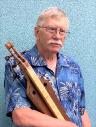
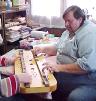
Bowing a dulcimer
Adventures with 'other' instruments...
Wow! I'd love to see (and hear!) you play, Mike!
Mike,
I'm curious about how you hold the dulcimer when bowing. Do you use a fiddle bow? Are you playing both fast and slow tunes?
I really like the sound of a mountain dulcimer that is bowed!

Mike,
If you have any photos of your bow or sound clips of you playing, I'd love to see them.
I don't know about guitars, but....The old european bowl back mandolins fell out of favor in America once mandolins began to be used in american style stringbands around 1920 and on. As I myself have found, they are very difficult to hold still against your stomach or chest while standing to play, as in a stringband setting on a stage. They slide and tilt too much because of the round back, not that they fall (since they have a shoulder strap). Sitting with one in your lap was not as much of a problem.European dulcimer ancestors were more often played on a table. Americans seem to have developed a preference for playing the early american dulcimers in their laps. I have equal difficulty keeping hourglass, teardrop, and galax eliptical dulcimers on my lap while playing fast fiddle tunes- I need a strap. The 'balance' effect of mirrored bouts doesn't seem do a thing for me to keep the instrument stable on my lap to play, i'm afraid. I seldom strum in the strum hollow- I find further up to give the best 'bounce' and tone. Usually about at the halfway point between the bridge and wherever I am currently fretting. I do the same with banjo.Now having the fretboard in the middle of the instrument might indeed make it easier to play on the lap. It would also make it easier to bow I'd think, though weren't some of the european ancestors/relatives bowed on a table, such as the Langeliks?It will be interesting to me to see how this works itself out when I get my 'traditional' style epinette des vosges next Spring. I'll report back here if I can remember. :)Anyone remember those round back guitar from the 70's? They fell out of your lap like a drunken cheerleader at a frat party!
Berimbau
Hi Berimbau,Can you explain why you feel this is so?thanks!Again it's far easier to strum a faster tune on an Appalachian dulcimer than it would be on a sheitholdt or other earlier zither form Berimbau
... the bridges on most older dulcimers do not easily lend themselves to good bowing technique. Besides, the fiddle was already present throughout Appalachia, and was in fact already the premiere instrument of the region.I was mostly alluding to earlier forms of the dulcimer -- zitters and such -- that seem to have been used more for hymn singing than for hoedowns; and more by German-American radical sectarians than by either Anglo-Americans, or more mainstream Protestants of any ethnicity. There was some documentation of that tradition just as it was fading from the scene, perhaps about as late as WWI, but mostly in the 19th century. What little we have about it in the written record has been reviewed on various ED threads, especially by Greg Gunner (Banjimer, there).But even the links with German pietists, Mennonites etc. may be more apparent than real; the people who saw fit to write on this obscure topic (the bowing of diatonic zithers) were after all in Pennsylvania, and surrounded by those folks. If Henry Mercer had collected in the vicinity of Burkesville, KY or Red Boiling Springs, TN around 1910, he might have found Scotch-Irish hillbillies bowing dulcimers. And btw calling them Frog fiddles.Anyway, it was done here and there, in Appalachia and elsewhere, a few generations before Ken Bloom was on the scene. The need perceived by violinists and their sympathizers for "good bowing technique" is fairly irrelevant, if one is using a slack, homemade bow -- and letting one's drones be drones. So the flat bridge is OK, really. On an old TMB, it's built-in (the "bridge" is a piece of sheet metal bent over a nail, as is the nut). That didn't keep people from bowing a TMB.That's not quite the same as bowing a psalmodikon -- an instrument that normally has one string, and frets at every semitone (though it may also come with a set of diatonic transposing sticks, painted with the gapped scales for playing in several different modes). With one string, the top of the bridge can be flat, arched, concave, or whatever.Dick
Psalmodikons were also bowed, and still areHere's a clip of that (in Sweden, I think): http://www.stthuset.com/tidning/film/viavinga/psalmdiakon/index.htm I can read Swedish, but this clip is just a link -- and there's no caption, that I could see, telling where the group is playing. Some of the members of this organization are in Norway.Dick
There are less than 100 of those floating around the US... Most of them seem to be below the Mason Dixon lineI just looked at the "About Ken" page on http://www.boweddulcimer.com/ and found this:"He has presented these programs at National battlefields, Living History sites, Highland Games, and schools all over North and South Carolina, Virginia, Tennessee, and Kentucky."Seems to be a correlation between seeing Ken Bloom and owning, or playing, a bowed dulcimer.I think there may be a great many more old dulcimers floating around that have been bowed, but not lately -- and we just don't know it.Those who bowed them a little deeper in the past than 1972 were not necessarily also violinists, or cellists; some bowed them noter-and-drone style, and some leaned them on a table with the head away from the seated player.Psalmodikons were also bowed, and still are -- mostly well to the north of the Mason-Dixon line, because that's where most of the Nordic population settled. http://www.psalmodikon.com/AnnualMeeting.html Just a little grist for the mill.Dick
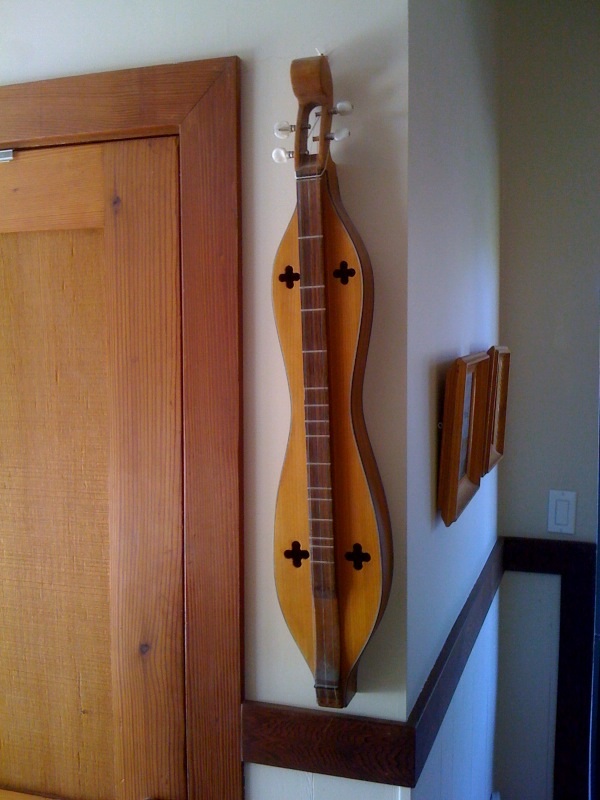
Unfortunately Deborah is 500 miles away from my place in Montreal. The next time we get together, I'll make a recording of her playing. I wish I'd done so already!MichaelThanks for the info Michael - now can you obtain a recording of her playing it???!!!???
Wow, so that's like about the same size as a regular mountain dulcimer! Pretty big.The Epinette des Vosges I am having made for me will have a scale length of somewhere around 19". =8-oI imagine the two instruments will sound very different from each other!Deborah measured the VSL - 27 inches.
Lisa,Deborah measured the VSL - 27 inches.MichaelWow, what an instrument! And 8 strings, too.
Do you know what its scale length is?
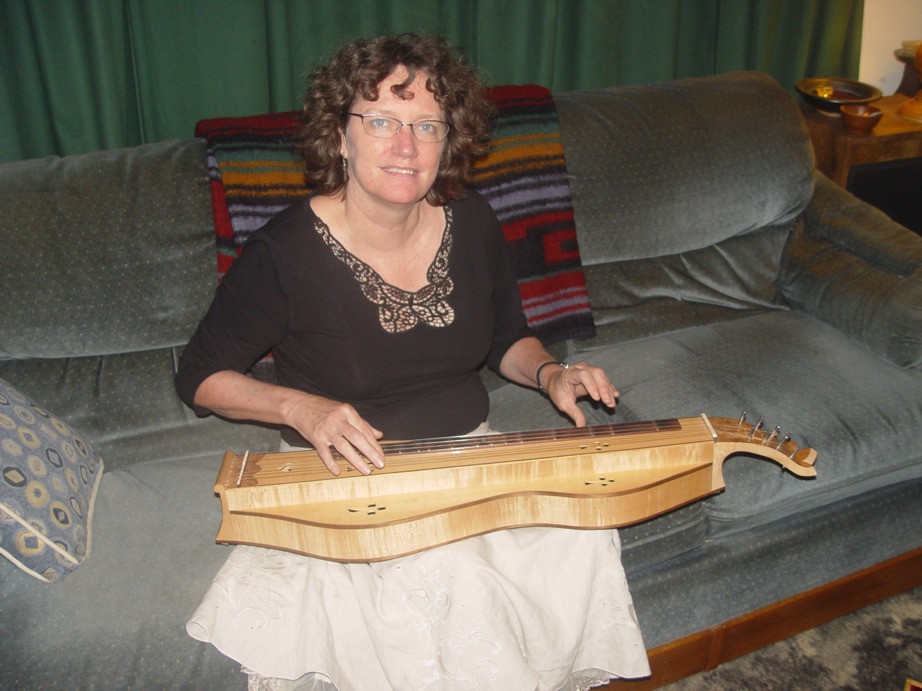
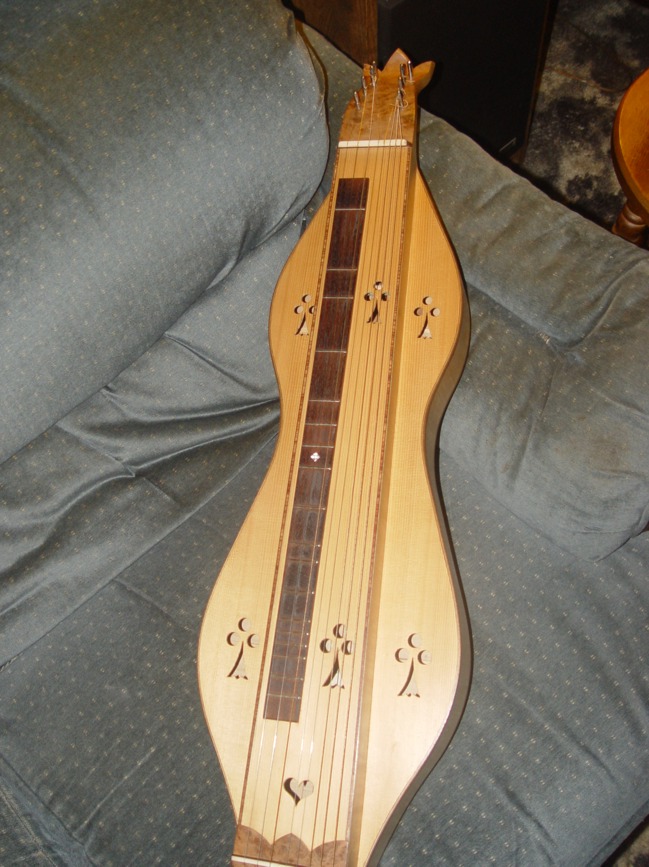
Yes that is what I thought - other pics I have seen of old epinettes look just like the upper part of this instrument - like on these links posted by Patrmigan in the "Ancestor of the Dulcimer" group http://mountaindulcimer.ning.com/group/dulcimerancestors/forum/topics/epinette-des-vosges-france Maybe the luthier was curious about inter-breeding?? It is beautiful and that double sound box arrangement must give it a very special voice.I find this interesting- the way it has the effect of two soundboxes. It's almost like an epinette on top, mating with a mountain dulcimer! =8-o I've never seen pix of an epinette des V. with an hourglass shape before. I'm guessing it's an innovation/experiment by the luthier, but i might be wrong about that.
In any case, it's pretty amazing!
Here's some individually wrapped leftover Halloween candy -- not everybody on FOTMD is so @#$% healthy...
Sorry, I ate the last ones. Have a pickled egg instead.no problem.. here's your cider... pass the cookies please...
Thank you. :)Friends of the Mountain Dulcimer is growing slowly but surely (I think it's about four months old now).The best thing is that so many of our members are actively participating and really seem to enjoy being part of our little community. FOTMD is vibrant and full of bright enthusiasm!When I created it, I envisioned a place where both advanced players and brand new beginners could learn and grow side by side, and feel equally at home. A place that would appeal to advanced players yet have its highest goal be that of encouraging beginners. It amazes and delights me that FOTMD seems to be fulfilling that vision exactly. Its members are what make FOTMD special and successful ....it is each one of YOU who should be thanked the most! :)300 this morning!
Break out the bubbly.Congratulations, Strumelia. Thanks for creating the FOTMD site.Michael